
Amicus Brief: Clarence Jones III
CLARENCE Jones III v. the State of maryland
Filing Date
January 22, 2020
Charge
First-Degree Murder
Jurisdiction
Court of Special Appeals of Maryland
Partners
Innocence Network
Summary
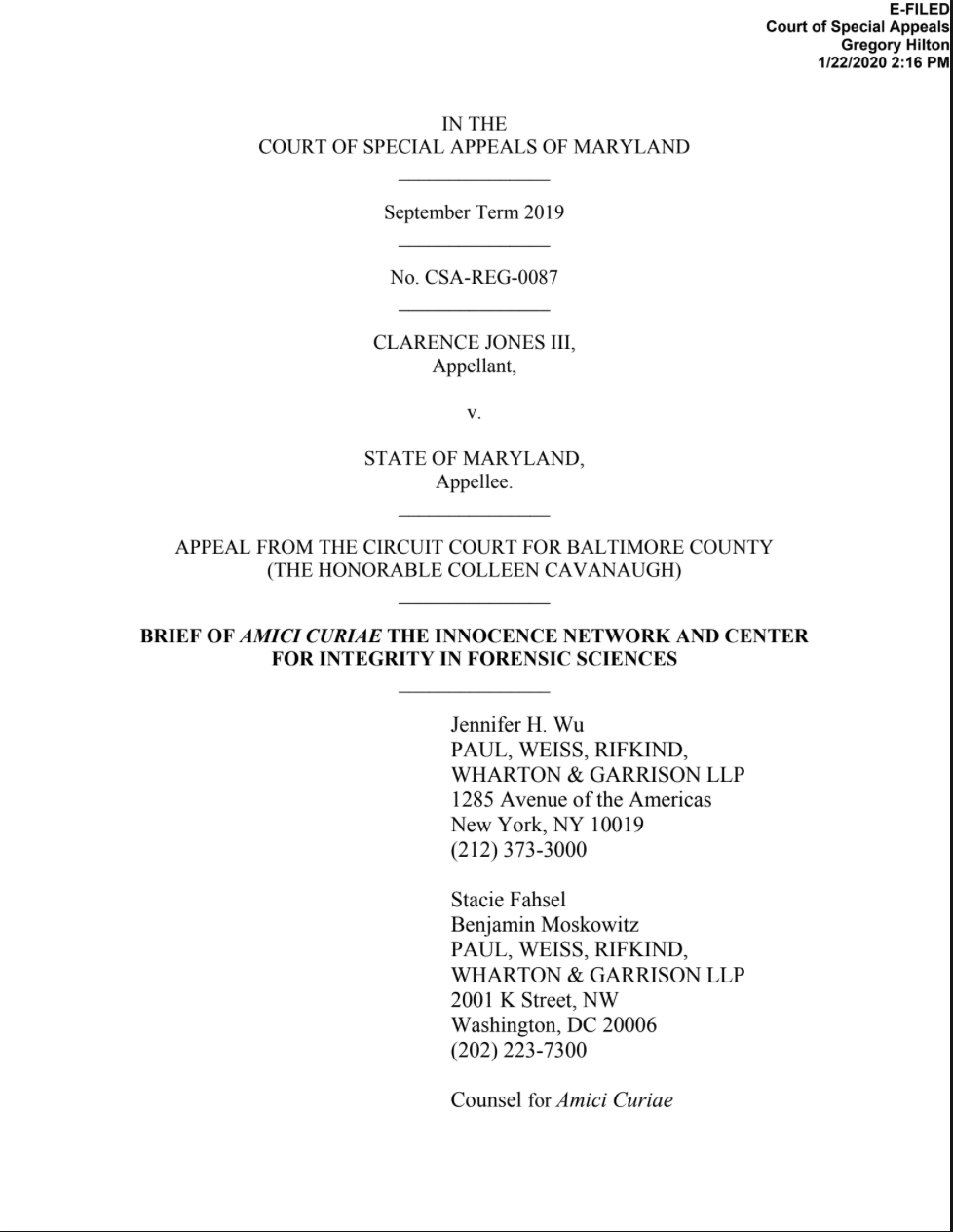
CIFS and the Innocence Network filed this brief in the Court of Special Appeals of Maryland in Clarence Jones’ case to argue that the shift in scientific understanding of SBS satisfies the newly discovered evidence standard and the court should overturn the denial of innocence petition and vacate his convictions.
PRELIMINARY STATEMENT
The Circuit Court erred by ignoring material scientific evidence that shaken baby syndrome or abusive head trauma hypothesis (the “SBS/AHT hypothesis”) is unsound. The SBS/AHT hypothesis is a diagnosis based on the theory that when an infant presents with three medical findings, sometimes referred to as the “triad”—(i) subdural hematoma, (ii) retinal hemorrhage, and (iii) cerebral edema or encephalopathy—it can be inferred that those findings were caused by abusive shaking. This hypothesis further assumes that the trauma would have caused symptoms to arise immediately and therefore was necessarily inflicted by the person who had physical custody of he child at the time that the symptoms arose.
The SBS/AHT hypothesis is unsound and therefore poses a serious risk of wrongful conviction. Scientific evidence—including substantial evidence developed after the 1999 trial of Mr. Jones—has made clear that these medical findings can be attributed to a wide variety of causes (such as natural disease or injury during birth) that are completely unrelated to shaking or intentional injury. As a result, it is now generally accepted that the presence of the “triad” (or its components) does not by itself give rise to a reliable diagnosis of abusive shaking. Because of the scientific community’s lack of understanding of the SBS/AHT hypothesis, Collin’s medical team and the State’s medical experts did not seriously consider other known causes of the medical findings. Specifically, the trial court credited medical experts who testified that the most likely explanation for baby Collin’s findings was abuse by the father (that is, Petitioner). But their testimony was based on: (1) the assumption—now known to be scientifically erroneous—that the only explanation for baby Collin’s findings was abuse; and (2) the medical communities’ ignorance of the variety of maladies—many of which Collin suffered from—that can be confused with, but are not, child abuse. The Circuit Court compounded its error by finding that nearly all of the Appellant’s evidence was not newly discovered and that it was not material. True alternative hypotheses were not presented to the trial court that would have established that the SBS/AHT claims were based on outdated scientific theories and thus incorrect.
Accordingly, the Network and CIFS support Appellant’s request that the Court overturn the denial of his Innocence Petition and vacate his convictions.