
Amicus Brief: Gregory Sugg
Gregory Sugg v. People of the State of Colorado
Filing Date
August 27, 2026
Charge
Child Abuse (serious bodily injury)
Jurisdiction
Supreme Court of the State of Colorado
Partners
Korey Wise Innocence Project
Summary
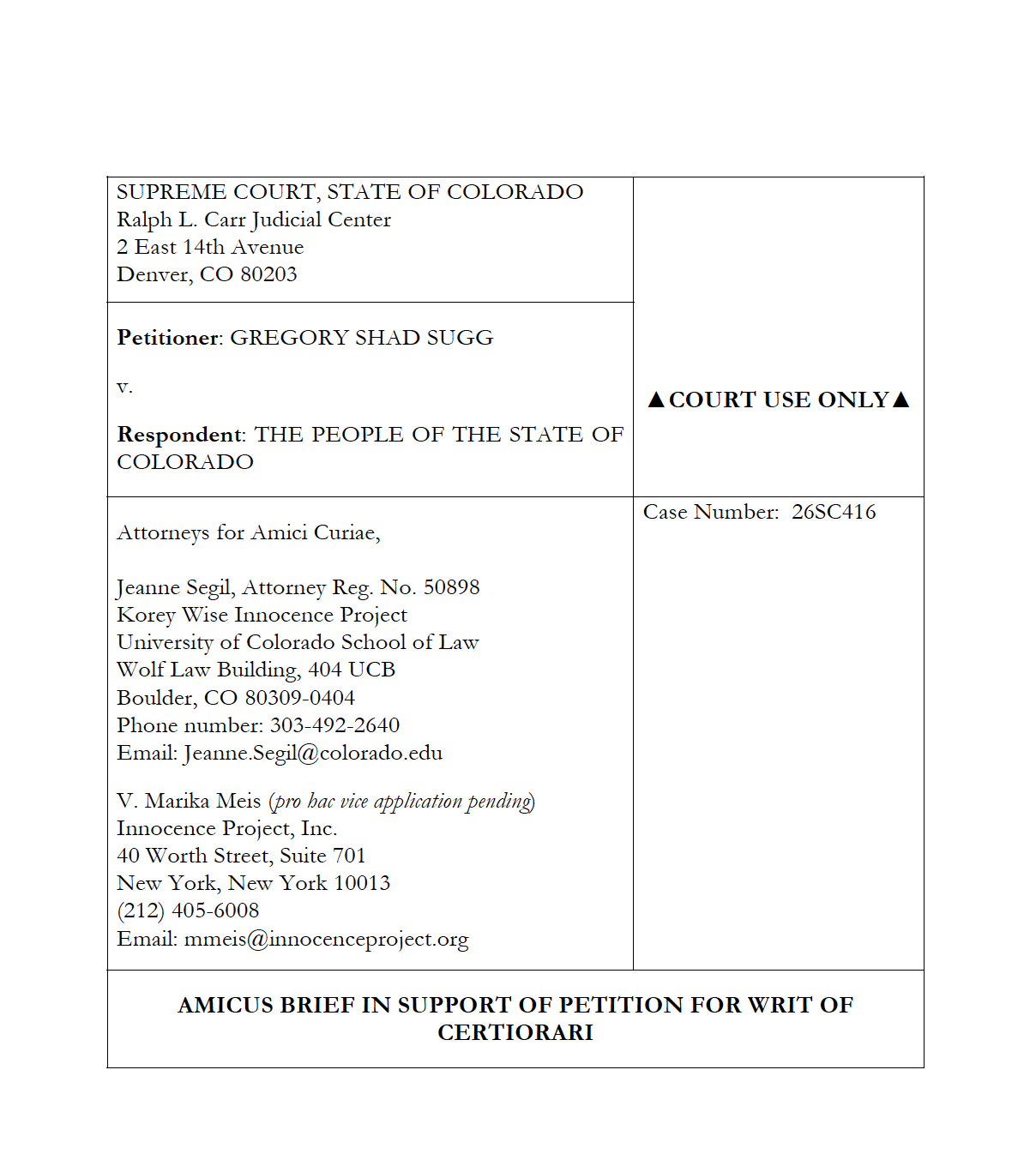
CIFS participated in this amicus brief in the Supreme Court of Colorado in Gregory Sugg’s case to educate the court on issues surrounding shaken baby syndrome. This amicus was submitted in support of Petition for Writ of Certiorari to determine the need for a Shreck hearing where the science has evolved.
PRELIMINARY STATEMENT
This case involves injuries to a 5-month-old infant, J.D., who had brain hemorrhaging and retinal hemorrhages in both eyes. The trial court admitted SBS/AHT expert testimony and an SBS/AHT diagnosis without a Shreck hearing.
AHT, and its predecessor, Shaken Baby Syndrome (“SBS”) assume that the presence of the “triad” of medical findings—subdural hematoma, retinal hemorrhage, and brain swelling—are definitive, “pathognomonic” proof of inflicted shaking or impact. From the 2000s to present day, however, mounting research, including biomechanical studies and investigations into alternative medical causes like birth trauma, natural hemorrhages, or short falls, have challenged the certainty of the triad. SBS/AHT has been shown to result in false accusations and wrongful convictions. Courts across the country had excluded or limited SBS/AHT testimony. To date, there have been a staggering 41 exonerations of parents and caregivers wrongfully convicted in cases based on SBS/AHT theories.
Against this backdrop, Mr. Sugg moved to preclude expert testimony that AHT caused J.D.’s injuries and use of the term “abusive head trauma.” The trial court denied the motion, without a Shreck hearing, and the Court of Appeals found no abuse of discretion. The courts below relied primarily on decades-old SBS cases, including People v. Martinez, 74 P.3d 316 (Colo. 2003). Mr. Martinez, however, was ultimately exonerated based on newly discovered evidence establishing that the infant in that case died of pneumonia, not SBS.
Reconsideration of the admissibility of a methodology that lacks or has fallen out of acceptance in the relevant scientific/medical community is core to the judiciary’s gatekeeping function. The trial court here failed at its gatekeeping function by ignoring the ever-growing rejection of AHT by the scientific and medical communities and decisions from courts around the country limiting and precluding AHT testimony.